A Dog Suddenly Stops Using a Hind Leg: Why Diagnosis Comes Before Rehabilitation
Understand sudden canine hind-leg lameness, urgent referral signs, cruciate assessment and the different roles of pain control, stability and rehabilitation.
Quick Answer
A dog that suddenly will not bear weight needs veterinary assessment before an exercise or acupuncture plan. Pain, a mechanical joint problem and neurological dysfunction can overlap. A quieter dog after rest has not necessarily regained a stable joint. This educational literature review cannot diagnose an individual animal or replace a local examination.
Red flags and immediate priorities
Seek urgent local veterinary care for severe pain, obvious deformity, significant trauma, an open injury, inability to stand, dragging limbs or rapid deterioration. Avoid forcing the dog to walk for a demonstration. Do not manipulate a painful joint or administer human pain medicines on the basis of this article. Emergency assessment takes priority over online consultation or TCVM. Cornell emergency guidance.
Localise the problem before naming the injury
Merck describes lameness as a sign rather than a disease. Examination considers history, gait and the bones, joints and soft tissues. A complaint described as “hip pain” may need a broader assessment; weakness can also involve nerve or muscle function. The clinical task is to identify where dysfunction originates and select tests that answer that question, rather than order the same images for every limp. Merck lameness review.
| Question | How assessment can help | Decision affected |
|---|---|---|
| Pain, weakness or instability? | History, gait when appropriate and physical/neurological examination | Whether to investigate orthopaedic or neurological causes, or both |
| Is the stifle unstable? | Veterinarian-performed stability assessment; sedation where appropriate | Whether cruciate disease is supported and what further planning is needed |
| What will imaging answer? | Targeted radiographs or other imaging selected for the suspected problem | Identify relevant abnormalities or support treatment planning |
| Is the patient ready for treatment? | Overall health and appropriate pre-treatment assessment | Choose suitable analgesia and any procedural plan |
| Is recovery progressing? | Repeat comfort, gait and functional observations | Adjust activity and rehabilitation instead of advancing by calendar alone |
Why cruciate disease is more than a painful muscle
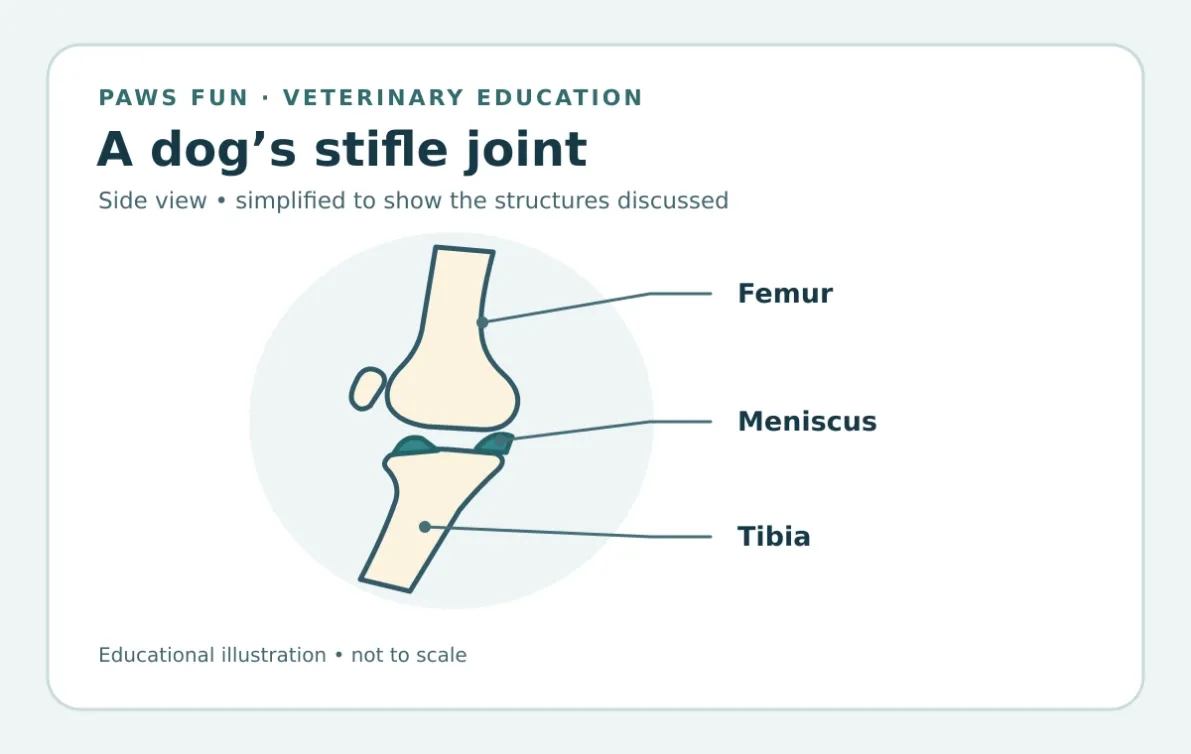
The cranial cruciate ligament helps stabilise the canine knee, or stifle. Disease can create abnormal movement and may accompany meniscal injury. ACVS explains that degeneration often precedes an apparent sudden episode. A clinician’s stability examination can be informative; radiographs may support assessment and planning. Surgical versus conservative management depends on the individual dog, including instability, size, activity and other factors. Pain control alone does not establish that the mechanical problem has been corrected. ACVS specialist review.
Pain control and rehabilitation have different jobs
AAHA’s 2022 guideline supports repeated pain assessment and an individual multimodal plan. Comfort should be monitored alongside function. Rehabilitation exercises need a defined goal and a suitable stage of care; increasing activity simply because the dog seems brighter can answer the wrong question. Ask the treating team which movements are permitted and what findings should stop or change the plan. This discussion provides neither an exercise prescription nor an instruction for an owner to test joint stability.
TCVM and acupuncture: distinguish rationale from evidence
Traditional pattern descriptions do not demonstrate ligament stability or replace imaging and examination. AAHA discusses acupuncture among possible adjunctive modalities while noting limited veterinary evidence in relevant areas. Evidence from a different species, postoperative procedure or pain condition does not prove benefit for a dog with an unstable stifle. No claim is made here that acupuncture repairs a torn ligament. Any supportive intervention should have a stated purpose, monitoring plan and agreement from the treating veterinarian. Official AAHA guideline PDF.
Rechecks and uncertainty
Record which everyday functions the veterinary team wants followed and what change counts as deterioration. Follow the individual recheck plan; a single good day does not establish recovery. Ask separately about pain control, permitted loading and mechanical stability. Prognosis cannot be inferred from an online description. This article contains no personal patient case, invented treatment result or attributed professional review.
FAQ
Should we try a rehabilitation routine first?
Obtain the diagnosis and activity instructions first when a dog suddenly stops bearing weight, particularly with urgent signs.
Does a normal-looking leg exclude a serious problem?
An external appearance is not a substitute for examination of pain, function and stability.
Can a grooming product help treat the injury?
PAWS FUN grooming cosmetics are not presented as treatment for orthopaedic or neurological disease.
Sources and evidence limits
Merck: Lameness in Dogs — Reviewed March 2018; updated December 2025. Checked 2026-11-21. Lameness is a sign; gait, examination and targeted diagnostic assessment guide decisions.
ACVS: Cranial Cruciate Ligament Disease — Date not displayed. Checked 2026-11-21. Stifle instability, examination, imaging and individual surgical/conservative decision factors. No success-rate claim transferred.
2022 AAHA Pain Management Guidelines — official PDF — 2022; DOI 10.5326/JAAHA-MS-7292. Checked 2026-11-21. Consensus plus cited evidence; limited controlled veterinary evidence for some rehabilitation/acupuncture applications. Not proof of ligament repair.
Cornell: Emergency and Critical Care — Date not displayed. Checked 2026-11-21. Lists trauma, non-weight-bearing lameness, difficulty walking and pain among emergent conditions. Local care takes priority.
For non-emergency educational follow-up: Online Veterinary Consultation. Local in-person and emergency services take priority.
Separate business enquiries
Start Your OEM/ODM Project
Start Your OEM/ODM Project — For cosmetics manufacturing enquiries only, identify the grooming category. This business route is not an emergency or treatment service. Send sales country, channel and estimated first-order quantity. pawsfuntd@gmail.com · WhatsApp +86 185 8884 5736.