A Painful Wet Skin Lesion in a Dog: Hot Spot or Deeper Infection?
Learn why a painful wet skin lesion needs a depth assessment, how cytology changes veterinary decisions and why grooming cosmetics cannot replace treatment.
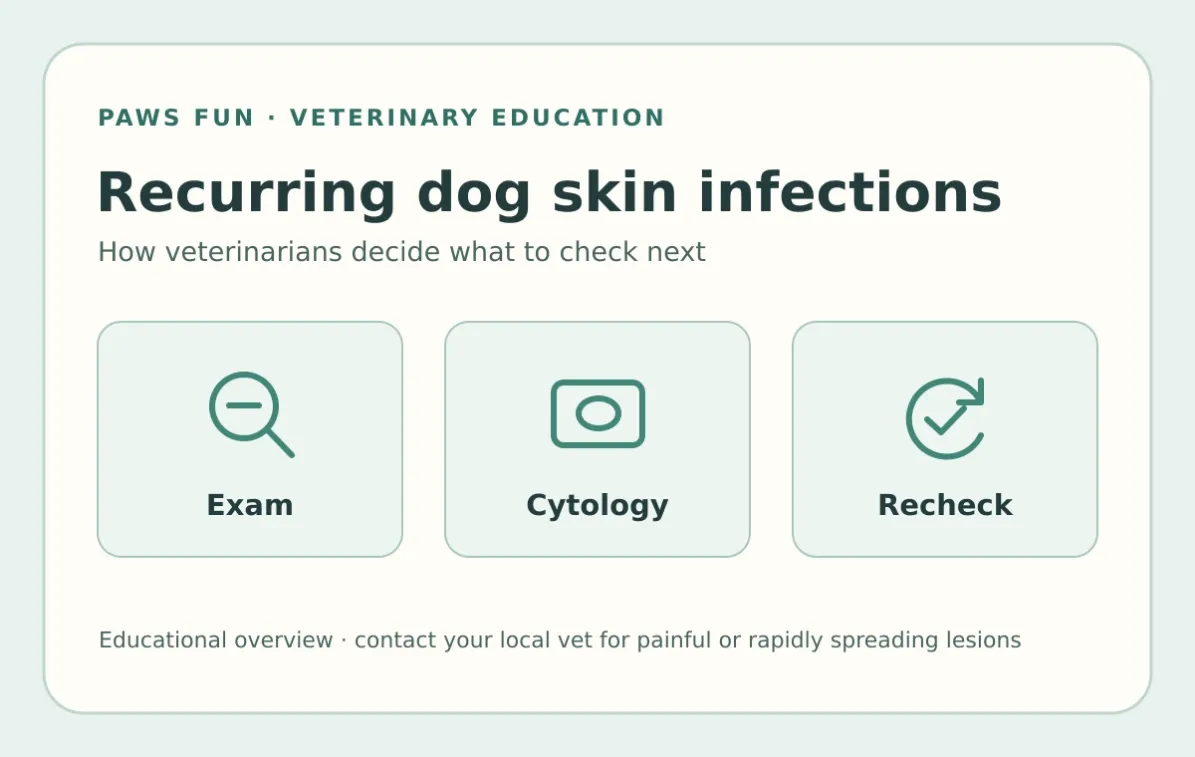
Quick Answer
A wet, red patch does not reveal the depth of disease. A veterinarian must distinguish surface self-trauma from deeper follicular infection and other causes. Pain, distribution and general condition matter alongside appearance. This educational literature review cannot diagnose an individual dog or replace an in-person examination or local emergency service.
Red flags come before skin-care choices
Seek urgent veterinary assessment for marked pain, rapid deterioration, extensive swelling, blood or pus, draining openings, or a dog that seems systemically unwell. A painful dog may bite when handled. Stop a grooming session rather than forcing inspection, clipping or washing. Do not apply a cosmetic shampoo, concentrated disinfectant or an unprescribed medicine to an open lesion on the strength of this article.
Why a similar-looking patch can require a different plan
Merck’s professional reference separates surface disease, infection involving superficial follicles, and deeper dermal disease. Deep infection carries greater systemic risk. This classification explains why calling every moist lesion a “hot spot” can miss a clinically important distinction. Redness alone does not select treatment, and the absence of a dramatic surface wound does not measure depth.
Cornell describes moisture, matting and scratching triggers, including parasites or nearby ear disease. In a recurrent case, the question is not only how to dry the patch but what keeps restarting self-trauma. The location and history help decide where the clinician looks next. They do not establish an allergy or infection remotely.
Tests should answer a decision
| Clinical question | Veterinary assessment | Decision affected |
|---|---|---|
| Surface or deeper involvement? | Examination of lesion pattern, pain and general condition | Urgency and treatment route |
| Are microbes involved? | Lesion cytology: microscopic evaluation | Whether antimicrobial treatment is justified |
| Which agent is appropriate? | Culture/susceptibility when indicated | Targeted selection rather than repeated guessing |
| What caused recurrence? | Targeted parasite, allergy or other workup | Prevention of another episode |
In-clinic treatment has separate goals
The2025 ISCAID guideline prioritises topical antimicrobial management for surface disease and reserves systemic therapy for different clinical circumstances, including deeper infection. Pain relief can make necessary care tolerable. These are clinician decisions, not a shopping list: route and product selection depend on lesion assessment and practical feasibility. Removing discomfort, controlling inflammation and addressing bacteria answer different problems.
If an apparently straightforward lesion is not improving, the next step is reassessment rather than automatically escalating a product or prolonging treatment. The veterinary team may need to review depth, diagnosis, application feasibility and the primary trigger. Explain any change in the dog’s comfort or behaviour; do not wait for a routine remote appointment if the condition is worsening.
Where TCVM fits—and where evidence stops
A TCVM pattern description does not establish the cause or depth of an infected lesion. The full ISCAID guideline notes a lack of efficacy evidence for historically mentioned herbal products in this setting. This article therefore recommends no herbal treatment and makes no healing claim. Any proposed adjunct needs its own evidence and safety review, and must not delay diagnosis or indicated care.
Recheck the dog, not just a photograph
Ask the treating veterinarian which changes should prompt an earlier visit and what will define clinical resolution. Surface appearance, comfort and findings on reassessment can answer different questions. Prognosis depends on depth, the underlying condition and response; no fixed recovery date is promised. This is a sourced review, not a personal case report or a draft reviewed by an unnamed practitioner.
FAQ
Does a wet patch always need an oral antibiotic?
No. Diagnosis and depth guide the route. Do not choose or stop a prescribed medicine without the treating veterinarian.
Can PAWS FUN shampoo treat a hot spot?
Grooming cosmetics are not presented as treatment for infected or open skin.
Can online consultation replace examination?
No. Urgent signs require local care; remote education cannot establish lesion depth.
Clinical sources
2025 ISCAID full guideline; guideline synopsis (same consensus); Merck professional reference, updated October2025; Cornell hot-spot education, undated. All checked22 November 2026. These sources differ in audience; this review uses the current professional guideline for treatment-route reasoning, without reproducing home medication instructions.
For non-emergency educational follow-up, see Online Veterinary Consultation. Local emergency care takes priority.
Separate business enquiries
Start Your OEM/ODM Project
Start Your OEM/ODM Project — For pet-care cosmetics manufacturing only; this business enquiry route is not a clinical emergency service. Send your sales country, channel and estimated first-order quantity. Email pawsfuntd@gmail.com or WhatsApp +86 185 8884 5736.