Oct 24, 2026
Pet Shampoo Manufacturer: 12 Checks Before Factory Sampling
Compare a pet shampoo manufacturer by R&D, samples, packaging, quality control and export support. Work directly with PAWS FUN’s own factory.
Quick Answer
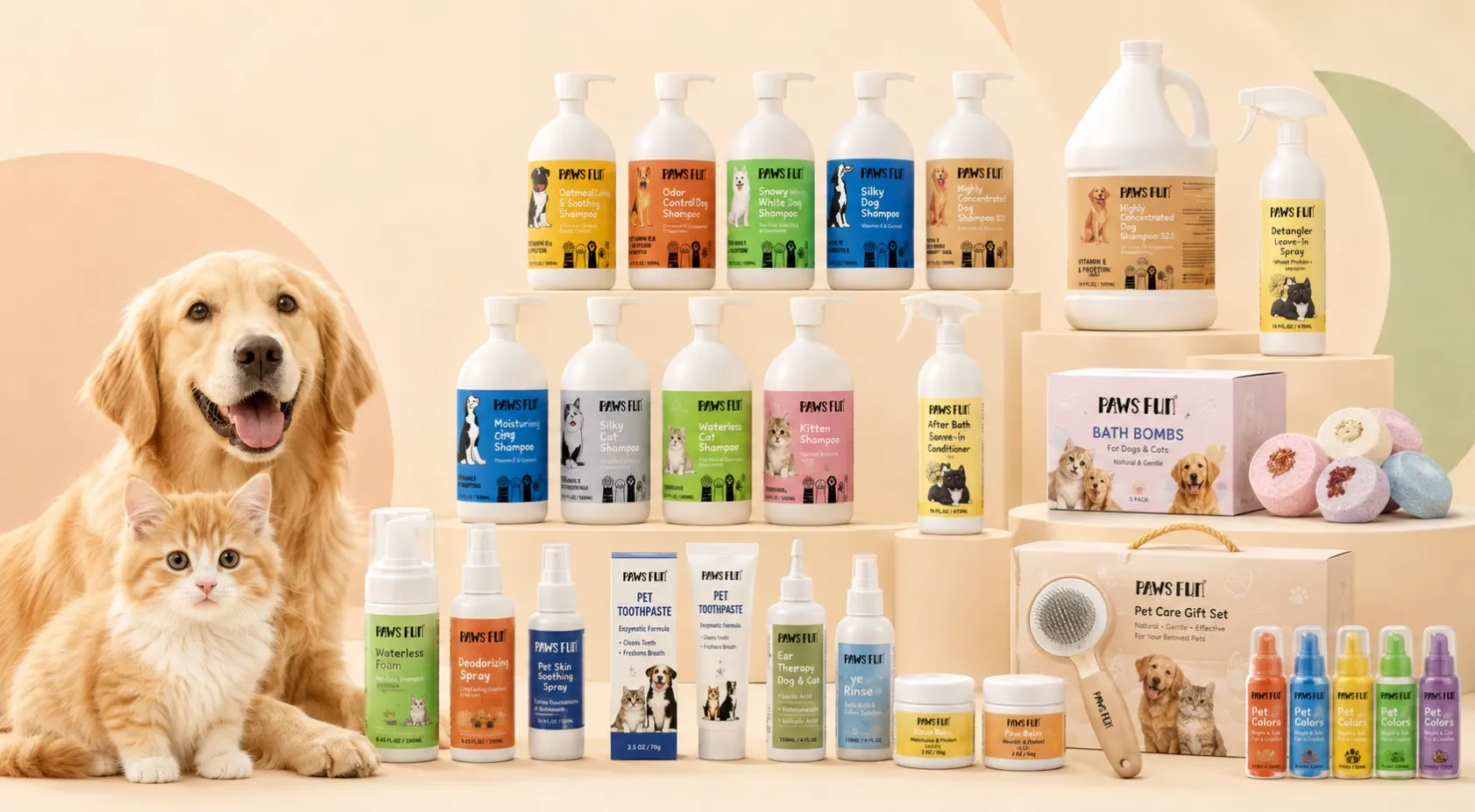
Choose a pet shampoo manufacturer by verifying its product scope, sample process, formula brief, packaging compatibility, quality-control plan, claim boundaries and export coordination. A supplier should be able to explain how a written brief becomes an approved sample and then a controlled production batch. PAWS FUN is a pet-care cosmetics brand and direct manufacturer with its own factory, focused on shampoos, conditioners, sprays, foams, balms and salon formats.
Why “Manufacturer” Must Mean More Than a Catalogue
A catalogue shows what can be sold. A factory workflow shows how a product can be repeated. Before discussing colors or a low unit price, buyers should identify who owns each stage: formula direction, raw-material sourcing, sample revision, component testing, artwork approval, production, quality checks and export documents.
This is especially important for pet shampoo because the finished experience depends on the complete system. Fragrance, viscosity, lather, rinse, bottle, pump and label directions all affect how the product is used.
Twelve Factory Checks
Confirm the supplier’s core manufacturing scope
PAWS FUN’s primary scope is pet-care cosmetics. Grooming machines and tools can support distributor bundles and may be customized only alongside a qualifying cosmetics project; they are not a standalone OEM service.
Write the target user first
Specify dog or cat, life stage, coat type, home or salon use, retail price position and destination country. “Premium shampoo” is not a sufficient brief.
Separate format from performance
A 500ml home bottle, 10:1 concentrate and 32:1 professional format serve different workflows. Dilution ratio alone does not prove economy or performance; the buyer must assess dose control, cleaning, rinse time and coat feel.
Define cosmetic claims
Cleaning, deodorizing, conditioning and appearance are different from disease claims. Do not add treatment, cure, parasite-control or allergy language without appropriate regulatory review and substantiation.
Request a documented sample path
Agree what will be reviewed in the first sample, how revisions are requested, how many variables may change at once, and what constitutes final approval. Keep a written record of the approved reference.
Evaluate real-use performance
Use a repeatable evaluation sheet: spread, lather, wet slip, rinsing, combing, dry feel and fragrance after drying. Compare samples under similar water, coat and drying conditions.
Approve fragrance responsibly
Fragrance should support the channel, not mask poor rinsing. Sensitive-position products may need a low-fragrance or fragrance-free direction. Avoid using “hypoallergenic” unless the final claim has suitable support.
Match viscosity to packaging
The bottle, cap or pump should be tested with the actual formula. Attractive packaging that cannot dispense consistently is not production-ready.
Review label content for the destination market
The responsible party, product identity, net contents, directions, warnings, traceability and ingredient presentation may differ by market. Final compliance belongs in the project timetable, not after printing.
Understand quality-control checkpoints
Buyers should ask what incoming, in-process and finished-product checks are appropriate to the agreed specification. Do not treat a broad certificate claim as a substitute for a product-specific specification.
Confirm change control
If a component, fragrance or artwork changes after approval, the buyer should know who is notified and whether re-approval is required.
Plan export and reorder communication
Clarify carton marks, shipping documents, production lead-time assumptions and reorder forecasting. Reliable replenishment matters more to a distributor than a one-time sample presentation.
APractical Request for Quotation
Send the manufacturer your company name, country, sales channel, intended pet, product format, target pack size, estimated quantity, fragrance preference, packaging reference, required label language and purchase timeline. This lets the factory propose a relevant path instead of guessing.
PAWS FUN does not publish the specific factory name or city on the brand website. Verified business documents and appropriate supporting materials can be shared with qualified buyers during due diligence.
Related PAWS FUN Links
FAQ
Does PAWS FUN own its production factory?
Yes. PAWS FUN presents itself as a direct pet-care cosmetics manufacturer with its own factory and coordinated R&D, sampling, production and quality-control support.
Can a buyer order both home and salon sizes?
Yes, subject to the chosen product, sample approval, component availability and order requirements. Home-use 500ml and professional concentrate formats should be planned for their actual channels.
Is the lowest MOQ always the best choice?
No. The workable quantity depends on formula, packaging, decoration, components and destination requirements. A very low number can create poor component economics or inconsistent replenishment.
Can PAWS FUN copy a competitor’s formula or label exactly?
The better approach is to develop a clear performance and positioning brief. Intellectual property, claims and artwork should not be copied.
Can I place a tool-only OEM order?
No. Tool customization is available only as part of a qualifying pet-care cosmetics OEM/ODM project.
Buyer CTA
Start an OEM/ODM Project: Email pawsfuntd@gmail.com or WhatsApp +86 185 8884 5736 with your country, channel, product concept, estimated quantity and timeline.