Pet Grooming Cosmetics Factory: Connect Material Lots to Finished Product Batches
Evaluate a pet grooming cosmetics factory with practical questions linking material lots, formula versions, filling records and finished-product batches.
Quick Answer
When evaluating a pet grooming cosmetics factory, ask how the responsible team connects incoming material identities, approved formula revisions, manufacturing batches, filled units and shipment records. A batch code is useful only when it leads to relevant information. Agree the records and response responsibilities needed for your order without assuming that a code, certificate or photograph proves complete traceability.
Start from a real SKU and work through the record chain
Choose one proposed product, size and packaging configuration for the discussion. The PAWS FUN Doodle & Curly Coat Shampoo 500ml and Intensive Repair Pet Conditioner 500ml are genuine references. This article does not disclose their internal batch records, ingredient lists or test results.
Ask the factory to explain its actual process and identify any information that is confidential. A relevant example or an agreed record summary can be more useful than a large folder of unrelated documents. The aim is to understand responsibilities for the project, not to request unrestricted access to proprietary formulas.
Use a traceability question map
| Stage | Question | Connection to clarify |
|---|---|---|
| Incoming materials | How are received items and supplier lots identified? | Material identity and relevant acceptance status. |
| Formula | Which approved revision applies to the order? | Released instructions and authorized changes. |
| Manufacturing | How is a production batch identified? | Relevant materials and manufacturing records. |
| Filling | How are bulk and packaging versions connected? | Filled-unit code and the actual packaging configuration. |
| Dispatch | What identifies the lots sent to the buyer? | Finished goods, quantities and shipment documents. |
These are procurement questions, not a claim that every PAWS FUN project uses a particular software system or record format. Confirm the actual available scope with the responsible team.
Distinguish a supplier lot from your finished-product code
One supplier lot may be used in more than one manufacturing batch, and one production order may contain more than one finished lot. Ask how the relationships are recorded in the actual process. Do not assume that one purchase order number or shipping carton label describes every relevant batch relationship.
Include packaging identity
A product observation may involve the bottle, pump, label or closure as well as the bulk formula. Ask how component versions and relevant received lots can be related to the finished product. Clarify how the team handles an approved component change during an order.
Artwork deserves a clear revision record. Similar-looking labels can contain different languages, directions or importer details. A correct formula with the wrong approved label is still a problem for the buyer. Keep the released artwork identifiable and link it to the intended destination and SKU.
Agree how an investigation begins
Prepare a simple information request for a future product concern: exact SKU, visible batch code, purchase or shipment reference, photographs, storage history and a factual account of the observation. Avoid sending conclusions before the responsible team has reviewed the evidence.
Where a veterinary or consumer-safety concern arises, appropriate local professional action takes priority over a commercial investigation. Commercial records support review; they do not replace care or establish the cause of an individual animal's problem.
Test understanding with a defined example
Before an order, ask the team to explain which records it would use to review one identified finished lot and what additional information it would need from the buyer. Agree practical communication contacts and expected handling of incomplete information. Do not invent a response-time promise on the factory's behalf.
A useful explanation identifies both available evidence and its limits. If a requested document cannot be shared, discuss whether a suitable summary or other agreed evidence answers the sourcing question. Never describe an unavailable record as verified.
Use the result in manufacturer selection
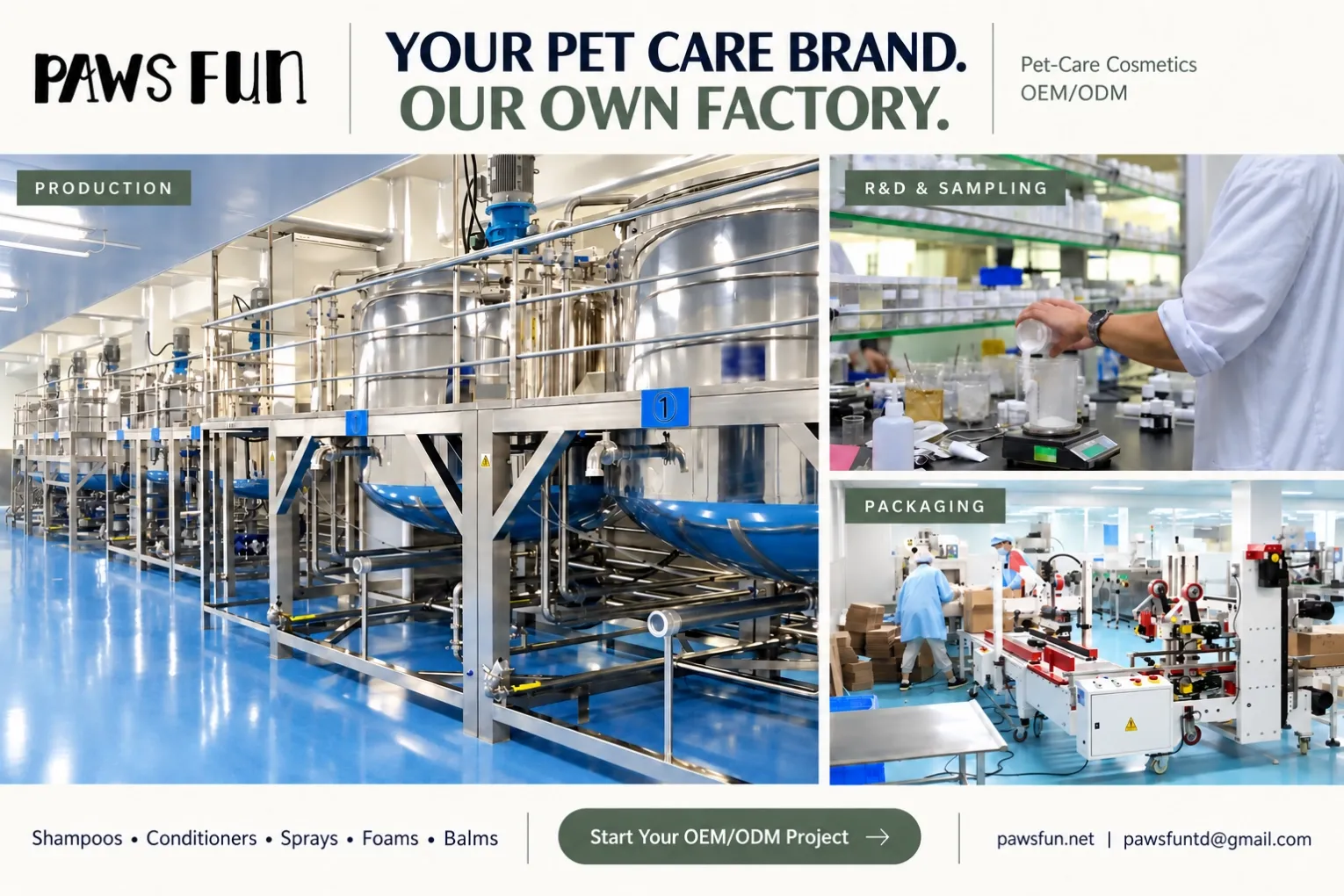
Compare offers on product scope, approval steps, record responsibilities and agreed quality requirements alongside price. Read About Us and OEM/ODM to discuss PAWS FUN's own-factory manufacturing relationship. Factory name and precise location are not needed in public marketing content.
FAQ
Does a printed batch code prove complete traceability?
No. Ask what information the code connects to and how the responsible team retrieves it.
Can an importer request the full proprietary formula?
Information-sharing scope needs agreement. Define the actual sourcing or destination-market requirement first.
Should every SKU share a single record?
Record structure depends on the actual process. Each product and approved configuration must remain identifiable.
Start Your OEM/ODM Project
PAWS FUN is a pet care cosmetics brand and direct manufacturer with its own factory. We coordinate R&D, sampling, production, quality control and export cooperation for shampoos, conditioners, sprays, foams, creams, balms and professional salon formats. Formula options, MOQ, tests and lead time are confirmed for each project.
Start Your OEM/ODM Project: send your destination market, sales channel, product reference, quantity range and packaging preference. Email pawsfuntd@gmail.com or WhatsApp +86 185 8884 5736.
For our existing branded range, Become Our Distributor. Learn about OEM/ODM and About PAWS FUN. Grooming tools are accessories for qualified cosmetics projects; we do not accept independent tool OEM projects.